Earning $50/hour as a nail artist isn’t about working harder; it’s about pricing smarter and running your freelance practice like a serious business.
- Implement non-negotiable business systems like deposits, travel fees, and clear cancellation policies to protect your revenue and time.
- Price based on total overhead, complexity, and brand value—not just time and supplies—to ensure every appointment is truly profitable.
Recommendation: Shift your mindset from a freelance artist to a premium service CEO by building the financial framework that your talent deserves.
You are a phenomenal nail artist. Your designs are intricate, your application is flawless, and your clients leave with miniature masterpieces on their fingertips. Yet, at the end of the month, your bank account doesn’t reflect your skill. This is the broke artist’s paradox: immense talent coupled with financial struggle. The common advice you’ve heard—”charge for your time,” “cover your supply costs”—is a platitude that keeps you trapped. It positions you as a hobbyist selling hours, not a professional delivering a premium service. To break this cycle, you must look beyond the polish and glitter to the unglamorous but essential core of any successful business: its systems.
Earning a target income of $50 per hour is not about painting faster or finding cheaper supplies. It’s about a radical mindset shift. It requires you to become a business strategist first and an artist second. This means implementing firm policies, calculating your true costs (including the ones you can’t see), and understanding the psychology of premium pricing. You must build a financial fortress around your art, one that protects you from no-shows, scope creep, and the brand-eroding allure of discounts. It’s about building a business structured for profit, not just for passion.
This guide provides the strategic framework to do just that. We will deconstruct the financial side of your freelance nail business, moving from reactive pricing to a proactive, profitable system. We’ll explore how to enforce deposits without alienating clients, calculate fees that truly cover your costs, and price complex art for its value, not just its time. It’s time to build the business that your artistry deserves.
This article will guide you through the essential business systems and pricing strategies needed to transform your freelance work into a profitable enterprise. Explore the detailed sections below to build your financial toolkit.
Summary: How to Price Your Nail Art to Earn $50/Hour as a Freelancer?
- The Non-Refundable Deposit: How to Enforce It Without Losing Clients?
- Travel Fees: How to Calculate Gas and Time for House Calls?
- Apps vs. Spreadsheets: What is the Easiest Way to Track Deductions?
- How to “Fire” a Toxic Client Who Tips Well?
- Hidden Costs: Why Did Your $30 Manicure Turn Into $65?
- Flat Rate or Per Item: How to Charge for Complex 3D Sets?
- Why Discounts for Referrals Can Hurt Your Brand Value?
- How to Use Seasonal Menus to Book Your Calendar 3 Months Ahead?
The Non-Refundable Deposit: How to Enforce It Without Losing Clients?
The single most powerful tool for transforming your freelance gig into a real business is the non-refundable deposit. It’s not a penalty; it’s a professional boundary. It filters out clients who aren’t serious and protects your most valuable asset: your time. A last-minute cancellation or no-show doesn’t just leave an empty hour in your schedule; it represents lost income that you can never recover. By requiring a deposit, you create a mutual commitment. The client secures their spot, and you secure your revenue. This simple policy instantly elevates your perceived value and communicates that your time is worth paying for in advance.
The fear of losing clients is often what holds artists back. However, the clients you lose over a professional deposit policy are often the same ones who would cancel last-minute or haggle over prices. The right clients—those who respect your skill and time—will understand and comply. The key to smooth implementation is clear, consistent, and automated communication. Your booking policy should be stated plainly on your website, social media profiles, and in your booking confirmation messages. Frame it not as a punitive measure, but as a standard procedure to secure a dedicated, one-on-one appointment. Professional salons have been doing this for years; a published salon policy example shows how some businesses set a clear $30–$50 booking deposit to secure appointments and reduce no-shows. By automating the process, you remove the personal awkwardness of asking for money upfront.
Your Action Plan: Automate Your Deposit Policy with Square Appointments
- Set Up Your Policy: In your Square Dashboard, navigate to Appointments → Settings → Payments & cancellations. This is your command center for revenue protection.
- Choose Your Protection: Select a booking payment policy that fits your business. Options like “Require full prepayment” or “Hold card in case of no-show” are both effective.
- Define Your Window: Set a firm cancellation cut-off window. This can range from 1 hour to 2 weeks, but 24-48 hours is a common professional standard. Save the policy.
- Configure the Fee: If using no-show protection, decide on the fee structure. You can choose a flat fee, a per-service fee, or a percentage of the booked service.
- Enforce Consistently: When a client violates the policy, enforce the charge through the system. This consistency depersonalizes the process and reinforces that it is a firm business rule, not a personal decision.
By making the deposit a non-negotiable part of your booking system, you are not being difficult; you are being a savvy business owner. It’s the first and most critical step in building a business that respects your own time and talent.
Travel Fees: How to Calculate Gas and Time for House Calls?
Offering mobile nail services is a fantastic way to provide a premium, convenient experience for your clients. However, if not priced correctly, it can quickly become a loss-leader that drains your profits and time. Your travel fee isn’t just for gas money; it’s compensation for your total cost of travel, which includes billable time, vehicle wear and tear, and insurance. Many artists make the mistake of charging a nominal flat fee or simply guessing, effectively working for free during their commute. To hit a $50/hour target, every minute must be accounted for, including the time spent in your car.

A professional approach involves creating a structured travel fee policy. The two most common methods are zone-based pricing and per-mile pricing. Zone pricing involves creating concentric circles or defined areas around your home base, with a set fee for each zone (e.g., $15 for 0-5 miles, $25 for 5-10 miles). This is simple for clients to understand. Per-mile pricing is more precise. A strong baseline for this is the official business mileage rate set by tax authorities. For instance, the IRS sets an annual standard mileage rate that is designed to cover not just fuel, but all operating costs of a vehicle. This rate reinforces the critical point that your fee must account for more than just gasoline; it covers depreciation, maintenance, and other “hidden” vehicle costs. Don’t forget to also factor in your own hourly rate for the round-trip travel time. If it takes 30 minutes to travel to and from a client, that’s 30 minutes you could have been working on someone else.
To calculate your fee, use this formula: (Round-trip mileage x Per-mile rate) + (Round-trip travel time in hours x Your target hourly rate) = Total Travel Fee. This ensures you are compensated for both your vehicle’s expenses and your valuable time, making house calls a profitable part of your service menu, not a costly convenience.
Apps vs. Spreadsheets: What is the Easiest Way to Track Deductions?
As a freelancer, you are a business owner, and that means tax season can be daunting if you’re not prepared. Every dollar you spend on legitimate business expenses—from glitter and gel polish to new files and e-file bits—can reduce your taxable income, putting more money back into your pocket. The key is consistent and organized record-keeping. Many artists get overwhelmed, thinking they need complex accounting software. This fear often leads to a shoebox full of crumpled receipts and a massive headache come tax time. But the secret to stress-free tracking is finding a system that is easy enough for you to use regularly.
The choice between a dedicated app (like QuickBooks Self-Employed, FreshBooks, or Wave) and a simple spreadsheet comes down to your personal preference and business complexity. Apps are fantastic for automating the process; you can link your business bank account, and they will help categorize transactions and even estimate quarterly taxes. They are designed for people who aren’t accountants. A spreadsheet, on the other hand, is free and highly customizable. You can create simple columns for Date, Vendor, Category (e.g., Supplies, Tools, Education, Marketing), and Amount. The most important thing is not the tool you use, but the habit you build. The IRS itself offers surprisingly flexible guidance on this matter. As they state in their official guide for small businesses:
“Except in a few cases, the law does not require any specific kind of records.”
– Internal Revenue Service (IRS), Publication 583 (12/2024), Starting a Business and Keeping Records
This is incredibly empowering. It means a simple, well-organized spreadsheet is just as valid as expensive software, as long as it clearly shows your income and expenses. The “easiest” way to track deductions is the one you will actually stick with. Whether it’s snapping photos of receipts with an app or dedicating 15 minutes every Friday to update your spreadsheet, consistency is what will save you from overpaying on taxes and give you a clear picture of your business’s financial health.
How to “Fire” a Toxic Client Who Tips Well?
This is one of the toughest decisions a service provider can face. A client who tips generously but is chronically late, constantly complains, disrespects your policies, or drains your emotional energy presents a difficult conflict. The money feels good, but the cost to your mental health and business integrity is high. Letting go of a toxic client, even a high-paying one, is an act of protecting your brand and your well-being. Your time and energy are finite resources. Every hour spent with a draining client is an hour you can’t give to an appreciative, respectful one who makes your work feel joyful, not stressful.

Remember, you are the CEO of your business. You have the right to curate your clientele. Firing a client isn’t a personal attack; it’s a professional business decision. The key is to handle it with firm, polite, and brief communication. Do not get drawn into a lengthy explanation or an emotional debate. The goal is a clean break, not a negotiation. Prepare a simple, professional script and deliver it in writing (email is ideal) to create a record and avoid a face-to-face confrontation.
Your script can be as simple as: “Hi [Client Name], I’m writing to let you know that I will no longer be able to accommodate your appointments after [date of last service]. I truly appreciate your past business. If you’d like, I can suggest a few other talented nail artists in the area who may be a great fit for you. I wish you all the best.” This approach is professional, final, and offers a helpful resolution without placing blame. Letting go of that income might feel scary in the short term, but it opens up space for better clients who not only pay well but also respect you and your craft. The peace of mind you’ll gain is priceless and will ultimately make you a happier, more successful business owner.
Hidden Costs: Why Did Your $30 Manicure Turn Into $65?
Many talented nail artists unknowingly undercharge because they only price based on what they can see: their time and the cost of the polish. But the true cost of running a professional nail business is far greater. To build a sustainable career that pays a target of $50/hour, you must price for your total overhead, not just your direct costs. Your service price needs to cover a dozen “invisible” expenses that are essential to operating legally and professionally. These hidden costs are why a seemingly simple $30 manicure, when priced for real profit, might need to be $65 or more.
Think of your business like an iceberg. The nail art itself is the tip, but the massive, hidden base below the water includes:
- Consumable Supplies: Beyond polish, this includes files, buffers, acetone, cotton, gloves, and sanitizing agents. As one report on industry costs noted, basics like nail files and gloves have tripled in price, and a large container of acetone can jump from $8 to $30.
- Tools & Equipment: Your e-file, UV/LED lamp, desk, and chair all have a limited lifespan and will need to be replaced. A portion of their cost must be built into every service.
- Overhead: This includes rent (if you have a studio), utilities, business insurance, booking software subscriptions, and bank fees.
- Taxes: As a freelancer, you are responsible for self-employment tax (Social Security and Medicare), which is a significant percentage of your net earnings.
- Education & Growth: The cost of classes to learn new techniques is an investment in your business and must be recouped.
This is precisely why a $50/hour goal is so ambitious and requires such intentional pricing. With official government data highlighting how the median pay of $16.66/hour for manicurists is far from that target, it’s clear that standard market rates are not built on a profit-first model. To achieve your income goal, you must calculate these hidden costs and build them into your pricing structure. Your price isn’t just for a manicure; it’s for a professionally delivered, fully insured, and expertly executed service.
Flat Rate or Per Item: How to Charge for Complex 3D Sets?
Intricate, sculptural 3D nail art is where your artistic skill truly shines—and where your pricing strategy can either make or break your profitability. Undercharging for this highly specialized work is the fastest way to feel overworked and underpaid. The challenge lies in quantifying the value of art that can take hours to complete. A simple “add-on” fee often fails to capture the immense time, skill, and material cost involved. To protect your $50/hour goal, you must adopt a pricing model that scales with complexity: tiered flat rates or time-based pricing.
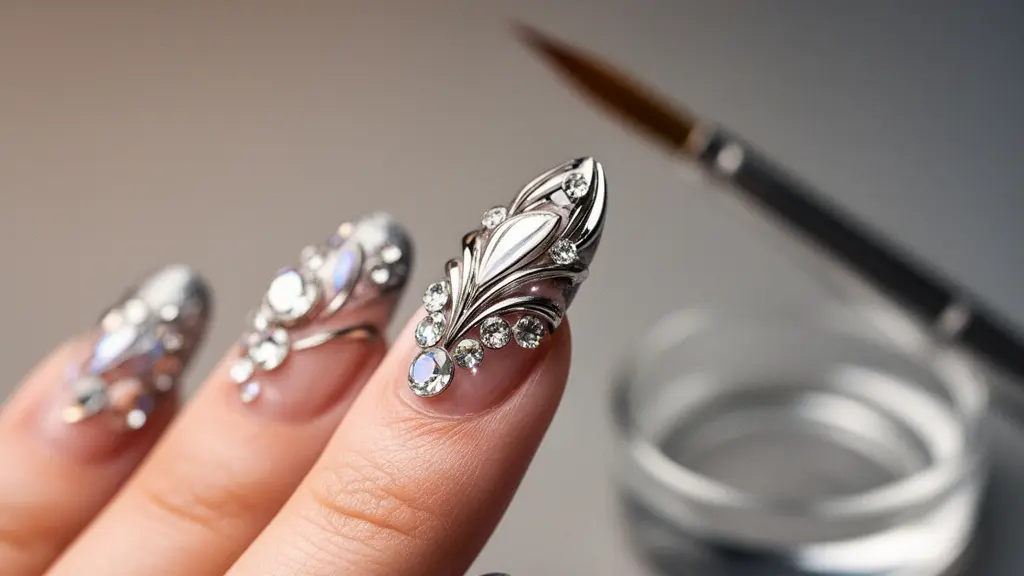
A “per item” charge (e.g., $5 per crystal) works for simple additions but falls apart for complex sculptural work. A better approach is to create pricing tiers. For example:
- Tier 1 (Simple): A flat rate for basic 3D elements on 2-4 nails (e.g., simple shells, bows).
- Tier 2 (Moderate): A higher flat rate for more detailed work across most or all nails.
- Tier 3 (Complex/Freestyle): An hourly rate or a “starts at” price for full-blown artistic sets that require significant design and application time.
This structure sets clear expectations for the client and ensures you’re compensated for the increased labor. When you see that some extreme 3D nail artists’ work can take up to 14 hours and cost thousands, with hourly rates of $110-$140, it reframes what’s possible. While you may not be charging that much, it validates the principle that highly artistic labor commands a premium price. Don’t be afraid to set your top-tier pricing based on an hourly rate. If a set takes you three hours, your price must reflect that. Your most advanced art is a luxury good, and it must be priced accordingly.
Communicating this requires a visual menu with clear examples of each tier. Show, don’t just tell. When a client sees a photo of a Tier 3 set next to its corresponding price, they understand the value they are paying for. This turns a potentially awkward conversation about price into a simple, professional selection process.
Why Discounts for Referrals Can Hurt Your Brand Value?
Offering a discount to a client for referring a friend seems like a win-win. You get a new client, and your loyal client gets a reward. However, for a premium service provider aiming for a $50/hour income, this common marketing tactic can subtly devalue your brand and erode your profit margins. When you offer a percentage discount, you are teaching both your existing and new clients that your services are worth less than your stated price. It positions your work as a commodity that can be had for a lower price, attracting bargain-hunters rather than clients who are willing to pay for quality.
The financial impact of discounts is also more significant than it appears. If your profit margin on a service is already slim, a seemingly small discount can wipe it out entirely. For example, a worked example shows how percentage discounts can erase margin fast; on a $30 item with a $10 profit, a 30% discount ($9) leaves you with only $1 of actual profit. Your goal is to build brand equity and a reputation for excellence, not to be the cheapest option available. Constant discounting trains your clientele to wait for the next sale, undermining the value of your full-price services.
So, how do you reward loyalty without sacrificing your brand? The answer lies in offering value-added rewards instead of cash discounts. These are perks that make your loyal clients feel special and enhance their experience without cheapening your core service. Consider offering:
- A complimentary add-on service, like a nourishing hand treatment or a small bit of freehand art on one nail.
- Early access to booking for your next seasonal menu or a new design collection.
- A small, high-quality retail product, like a deluxe cuticle oil.
These types of rewards reinforce your premium positioning. They say, “As a thank you for your loyalty, I want to give you something extra and special,” rather than, “As a thank you, my work is now worth less.” This strategy builds a community of true fans who value your art, not just a customer base looking for the next deal.
Key Takeaways
- Price for Profit, Not Just Costs: Your pricing must cover all hidden overheads—supplies, taxes, insurance, and education—to be truly profitable.
- Your Policies Are Your Protection: Non-refundable deposits, clear cancellation rules, and structured travel fees are non-negotiable systems that protect your income and time.
- Value Over Discounts: Build brand equity by rewarding loyalty with value-added perks, not by devaluing your work with discounts.
How to Use Seasonal Menus to Book Your Calendar 3 Months Ahead?
Once you have established your core pricing and business policies, you can move into proactive revenue generation. One of the most effective strategies for this is the seasonal or themed service menu. Instead of waiting for clients to come to you with random requests, you curate a limited-time collection of designs, colors, and add-ons tailored to an upcoming holiday or season (e.g., “Fall Spice Collection,” “Holiday Glam Menu,” “Spring Bloom Set”). This strategy does more than just inspire your clients; it creates urgency and encourages them to book far in advance to secure a spot.
By releasing a new menu every quarter, you create a powerful marketing event. Announce the upcoming menu on social media a month or two in advance, showcasing a few teaser designs. This creates buzz and allows your most enthusiastic clients to claim their appointments before your calendar even opens to the public. This tactic transforms your booking process from a reactive scramble to a predictable, manageable system. It gives you a clear view of your income for the months ahead and allows you to plan your supply orders and personal schedule accordingly.
The seasonal menu is also the perfect vehicle for high-margin add-ons. You can include special, themed embellishments or treatments that are only available for a limited time. A booking platform guide suggests keeping seasonal add-ons in an easy-to-accept $8–$20 band to increase uptake. This small, impulsive “yes” from a client can significantly boost the total value of the appointment without affecting your core service pricing. By becoming the creative director of your own brand, you guide your clients’ choices, streamline your workflow, and build a predictable, profitable, and fully booked business.
By shifting your perspective from that of a freelance artist to a strategic business owner, you can build the financial structure necessary to support your creative talent. Start today by implementing one of these systems—your future self will thank you.