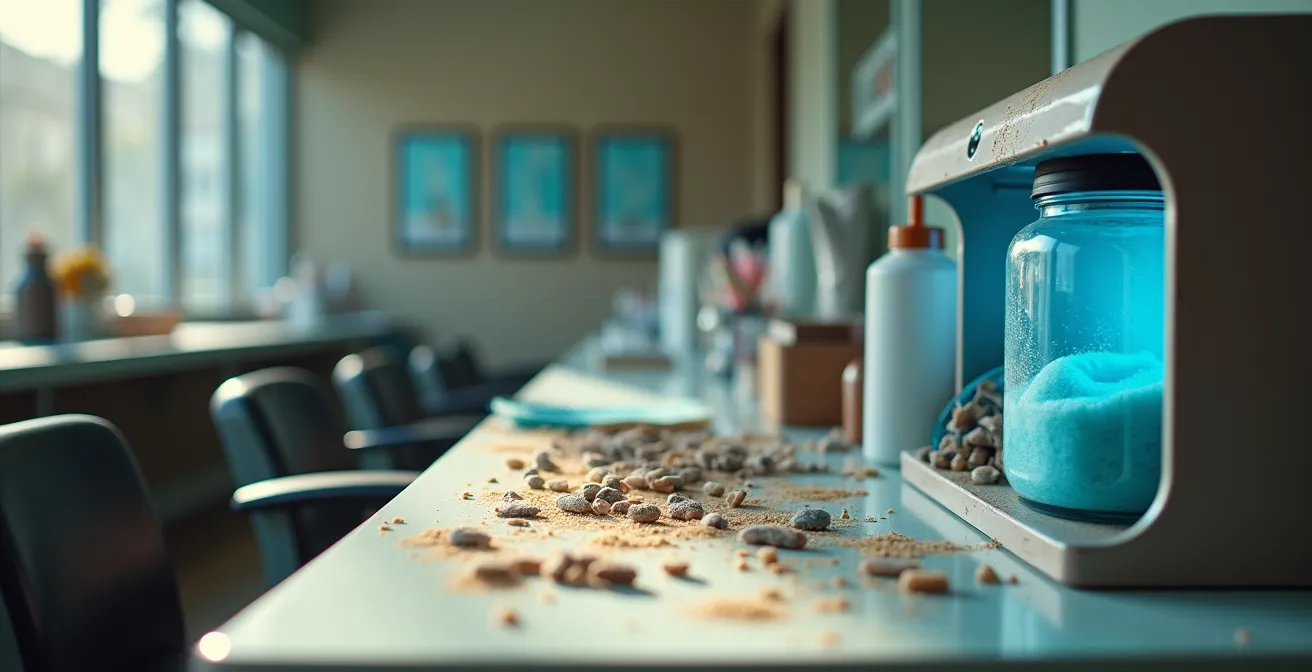
A visually clean salon isn’t always a safe one; the most dangerous red flags are often invisible to the untrained eye.
- Real safety is indicated by proper disinfectant contact times, not just blue liquid in a jar.
- A state-issued license, not just an artistic certificate from Instagram, is the only guarantee of essential sanitation training.
Recommendation: Adopt an inspector’s mindset to protect your health, not just your manicure.
The search for a new nail salon often starts with a scroll through Instagram and a glance at the prices. But the biggest complaint about nail salons isn’t a crooked nail or a chipped polish; it’s the unsettling feeling that something isn’t right. It’s the hidden upcharges that double the price, the rushed service that leaves you with painful cuticles, and the lingering question: can you get an infection from this? The reality is that the most dangerous salons—the “chop shops” built on volume over safety—have mastered the art of looking clean. They perform “hygiene theater,” banking on the fact that clients don’t know what to *really* look for.
You’ve likely been told to check for a license on the wall or to make sure they use new files. While true, this is entry-level advice. It doesn’t protect you from a technician who has a license but ignores their training, or a salon that reuses a “clean-looking” tool. The true key to safety isn’t just spotting the obvious; it’s about understanding the *why* behind the rules. It’s about developing an auditor’s eye for the subtle, high-risk violations that most people miss.
This guide isn’t about finding the cheapest or fastest manicure. It’s about empowering you with the insider knowledge of a state board inspector. We’ll deconstruct the myths, give you the language to advocate for yourself without being rude, and show you how to identify the non-negotiable red flags that mean you should walk out the door. By the end, you won’t just be a client; you’ll be an informed advocate for your own health and safety.
This article provides a comprehensive framework for evaluating a nail salon’s true commitment to quality and safety. We will explore everything from disinfectant effectiveness to the subtle signs of a rushed job, giving you the tools to make an informed choice.
Contents: How to Spot a “Chop Shop” Salon Before You Even Sit Down?
- The Blue Liquid Myth: Is Barbicide Actually Effective If Not Changed?
- How to Tell Your Tech You Hate the Shape Without Being Rude?
- Hidden Costs: Why Did Your $30 Manicure Turn Into $65?
- Speed vs. Quality: Is a 45-Minute Full Set Ever Good?
- How Much to Tip Your Nail Tech in 2024 Based on Service Complexity?
- How to Explain Your Sanitation Fee to Price-Sensitive Clients?
- What Are the Instant-Fail Violations During a State Board Inspection?
- License vs. Certificate: What Do You Actually Need to Work Legally?
The Blue Liquid Myth: Is Barbicide Actually Effective If Not Changed?
That iconic jar of blue liquid is the most recognizable symbol of salon sanitation, but it’s also the centerpiece of “hygiene theater.” A salon can look spotless, but if they aren’t using their disinfectants correctly, they might as well be using water. The effectiveness of Barbicide and other hospital-grade disinfectants is not in the color, but in two critical factors that are often ignored in a rush: proper dilution and contact time. The liquid must be mixed daily to the correct concentration and, most importantly, tools must be fully submerged for a specific duration.
A quick dip-and-pull is for show. For a disinfectant to actually kill bacteria, fungi, and viruses, it needs time. According to professional nail hygiene guidelines, metal implements must be completely submerged for a minimum of 10 minutes after being cleaned of all visible debris. If you see a tech pull a tool from the jar, wipe it, and immediately use it on you, you are witnessing a critical sanitation failure. The blue liquid is rendered completely ineffective, and you are being exposed to whatever was on the previous client.
Furthermore, observe the liquid itself. Is it cloudy or filled with nail clippings and debris? This is a clear sign the solution is old, contaminated, and no longer disinfecting anything. A professional salon changes its disinfectant solution daily, or even more frequently if it becomes visibly soiled. The blue jar is your first test as an auditor: don’t be impressed by its presence; be critical of its use. It’s the first and easiest place for a chop shop to cut a corner that you are now trained to spot.
How to Tell Your Tech You Hate the Shape Without Being Rude?
Advocating for the nail shape you want isn’t being difficult; it’s a crucial part of the service you’re paying for. However, the fear of seeming rude can often lead to silent disappointment. The key is to be collaborative, not confrontational, and to provide feedback at the right moments. The worst time to mention you dislike the shape is after the color has been applied. The best times are during the initial filing and shaping, right before the base coat goes on.
To make this process smooth, come prepared. An inspiration photo is your best tool. It removes ambiguity and gives both you and the technician a clear, shared goal. When you sit down, show them the photo and have a brief consultation. This is a moment of partnership. As they begin shaping, use the “one-nail checkpoint” technique. Ask, “Could we perfect the shape on my index finger first? That way we can make sure we get it just right.” This is a low-stakes, respectful way to course-correct early. It’s a small request on one nail, not a complete overhaul of all ten.
The image below shows the ideal moment for this conversation: a focused consultation where both client and technician are aligned on the goal before the most time-consuming work begins. Notice the collaborative nature of the interaction.

If you need to give feedback, be specific and reference the photo. Instead of a vague “I don’t like it,” try, “Looking at the photo again, it seems the sides are a little more tapered. Can we try to get closer to that?” This is constructive, not critical. A professional technician wants you to be happy with the result. By providing clear, timely, and polite feedback, you are helping them achieve that. And remember, once they’ve nailed the shape, a simple, “That’s perfect, thank you for working with me on this!” goes a long way in maintaining a positive relationship.
Hidden Costs: Why Did Your $30 Manicure Turn Into $65?
You walked in for a $30 manicure, but walked out with a $65 bill. This frustrating experience is a hallmark of the “chop shop” business model, which often relies on a low advertised price to get you in the door and a series of confusing upsells to inflate the final cost. A reputable salon is transparent about its pricing. An unprofessional one uses ambiguity and pressure to extract more money from you. Understanding the common culprits is your first line of defense.
The most frequent surprise charges are for services that clients often assume are included. These add-ons are not inherently bad if they are explained and agreed to upfront, but they become a red flag when they appear on the bill without prior discussion. To protect yourself, you need to know what to ask about before the service even begins. Don’t be afraid to clarify. Before your technician touches your nails, confirm the total by saying, “I’d like the service we discussed. Can you just confirm the final price for me?” Then, get specific: “Does that price include removing my current gel polish?” and “Is there an extra charge for a coffin or stiletto shape?” These simple questions eliminate ambiguity.
Case Study: Common Nail Salon Upsells and Deceptive Tactics
A comprehensive analysis of salon pricing reveals the most frequent surprise charges. These include gel polish removal ($5-$15), which is often a separate line item, specialty shapes like coffin or stiletto ($5-$10), and extra nail length ($10-$20). The study highlights a key difference: legitimate upsells are presented as choices with clear benefits, while deceptive tactics use fear-based selling. For example, a tech telling you your nails are “too weak” and you “need” an expensive strengthening treatment, without explaining alternatives, is a classic red flag for predatory pricing.
A good technician will welcome these questions as it ensures you are both on the same page. A technician who becomes evasive or makes you feel cheap for asking is showing a major red flag about the salon’s business practices. True professionals sell their skill and service, not pressure and products. Being a savvy client means being an informed one, and that starts with understanding exactly what you’re paying for.
Speed vs. Quality: Is a 45-Minute Full Set Ever Good?
In the nail industry, extreme speed is almost never a sign of skill; it’s a sign of a high-volume, low-quality business model. While an experienced technician is certainly more efficient than a novice, there are physical and chemical limits to how fast a quality service can be performed. Products need time to cure properly, nail plates need to be prepped without causing damage, and shaping requires precision. A 45-minute full set is a major red flag because it means critical steps were inevitably skipped.
The “chop shop” economic model is built on getting as many clients through the door as possible. This pressure to rush directly compromises both the longevity of your manicure and your health. When prep is rushed, the nail plate isn’t properly dehydrated, leading to lifting. When acrylic or gel is applied too quickly, it can flood the cuticles, causing painful irritation and lifting. Most dangerously, when shaping is done at high speed with an e-file, it’s incredibly easy to over-file the nail plate, causing heat spikes and long-term damage known as “rings of fire.”
This is further explained by industry experts who stress the importance of careful, methodical work. As the Cortiva Institute notes in its guide on salon safety:
While an experienced tech is faster, there is a physical limit to how fast products can cure and how quickly careful, non-damaging work can be done. Extreme speed is not a sign of skill, but of a high-volume, low-quality business model.
– Cortiva Institute, The Importance of Sanitation in Nail Services
The following table breaks down where corners are cut in a rushed service. A quality full set should take approximately 75-90 minutes. Anything significantly less should make you question what you’re not getting.
| Service Stage | Quality Time | Rush Job Time | What Gets Skipped |
|---|---|---|---|
| Prep & Sanitization | 10-15 minutes | 2-3 minutes | Proper nail dehydration, cuticle care |
| Application | 30-45 minutes | 15-20 minutes | Precise application, proper curing time |
| Shaping & Finishing | 15-20 minutes | 5-10 minutes | Careful shaping, smooth edges, quality check |
| Total Time | 75-90 minutes | 25-35 minutes | Overall precision and durability |
How Much to Tip Your Nail Tech in 2024 Based on Service Complexity?
After navigating the minefield of red flags and finding a technician who is safe, skilled, and transparent, showing your appreciation through a proper tip is the final step. Tipping in a salon isn’t just a courtesy; it’s a direct acknowledgment of the technician’s expertise, time, and the often intricate work they perform. The standard 15-20% is a good starting point, but in 2024, a more nuanced approach that considers service complexity is becoming the norm.
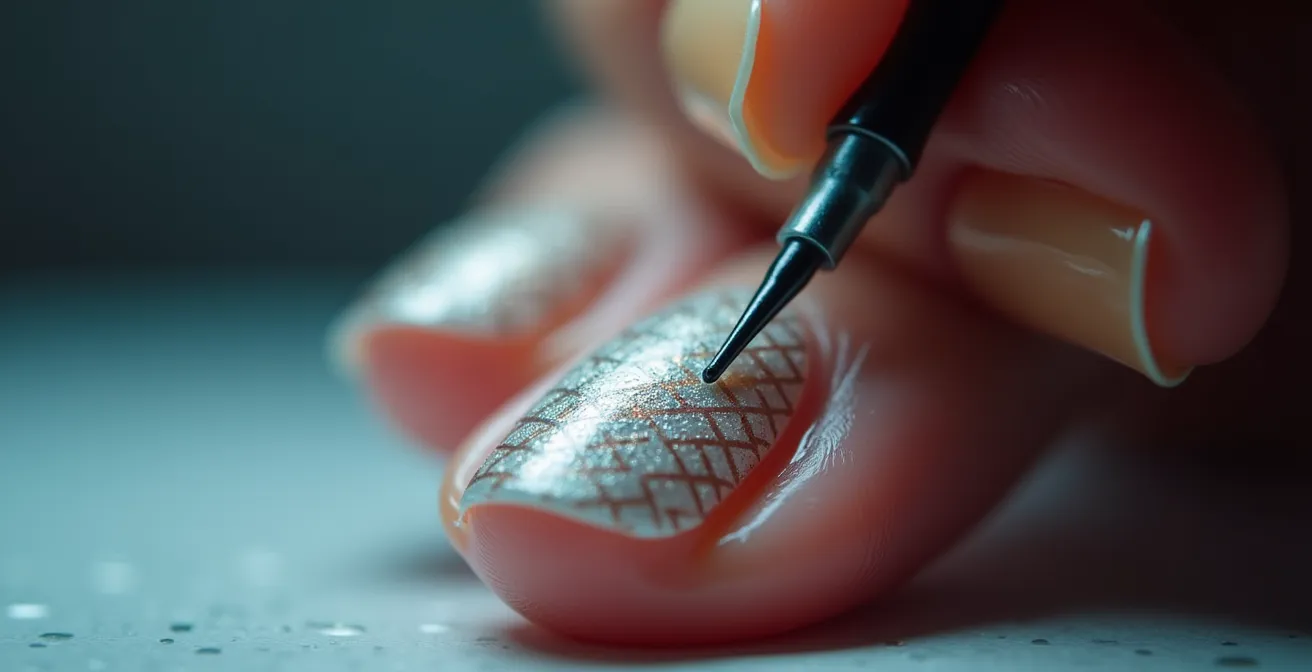
A simple polish change is not the same as a full set of acrylics with complex, hand-painted nail art. The latter requires significantly more time, a higher level of artistic skill, and intense concentration. When a technician spends an extra 30 minutes perfecting a detailed design for you, or meticulously fixes a bad job from another salon, their effort should be reflected in the tip. This is how you build a strong, respectful relationship with a great tech and ensure you remain a valued client.
This macro photograph of a technician at work highlights the incredible precision and artistry that goes into complex nail designs. This level of detail justifies a tip that goes beyond the standard baseline.
To remove the guesswork, here is a tiered guide for tipping your nail tech in 2024. Remember, if you received a discount, your tip should always be calculated on the original, full price of the service. And whenever possible, a cash tip is preferred as it goes directly to your technician without any processing fees.
- Basic service (simple polish change): 20% standard baseline
- Add 5% for intricate nail art or complex designs on multiple fingers
- Add 5-10% for fixing another salon’s poor work
- Add 5% for an exceptional consultation and a noticeably pristine hygiene experience
- For discounted services: Always calculate your tip on the original full price
How to Explain Your Sanitation Fee to Price-Sensitive Clients?
While this article is for clients, understanding how a *good* salon explains its fees is a powerful tool for you as an auditor. In recent years, you may have noticed a small “Sanitation Fee” or “PPE Fee” on your bill. In a chop shop, this can be a vague, unjustified cash grab. But in a high-quality salon, it’s a transparent investment in your personal safety, and they should be able to explain it to you clearly.
When you see this fee, don’t be afraid to ask, “Could you tell me what this sanitation fee covers?” An evasive answer is a red flag. A confident, professional salon will have a clear, proud response. They see it not as a hidden cost, but as a point of difference that highlights their commitment to your health. They are charging you for the guarantee that the tools touching your body are either brand new or medically sterilized, and never used on another client.
A great technician will explain the value you’re receiving directly. According to a best practices guide for salon hygiene, the ideal script sounds something like this:
We have a small $3 PPE & sanitation fee that allows us to guarantee a brand new file, buffer, and arbor band for you, and to run our medical-grade autoclave for all metal tools. It’s a direct investment in your health and safety.
– Professional Nail Technician Script, Best Practices for Safety and Hygiene in the Salon
Listen for those keywords: “brand new file,” “new buffer,” and especially “medical-grade autoclave.” An autoclave is a machine that uses high pressure and steam to sterilize metal tools, killing 100% of infective organisms. It is far superior to soaking tools in blue liquid. When a salon can confidently tell you that their fee pays for single-use items and autoclave sterilization, you know you are in a place that prioritizes your health over cutting corners.
What Are the Instant-Fail Violations During a State Board Inspection?
Now we move from red flags to non-negotiable deal-breakers. These are the “instant-fail” violations that a state board inspector would immediately write a citation for. If you spot any of these, it is not a time for discussion or giving the benefit of the doubt. It’s time to stop the service and leave. These practices pose a direct and immediate risk of transmitting bacterial, fungal, and viral infections.
The single most common and dangerous violation is the reuse of single-use items. Files, buffers, and wooden sticks are porous and cannot be sterilized. Once they have touched a client’s skin or nails, they are contaminated. Reusing them is like sharing a needle. Inspection data shows how rampant this problem is; according to state board inspection data from one investigation, there were 60 citations for reusing single-use instruments in Southern Nevada alone. A new file and buffer should be taken from a sealed package in front of you. If the tech pulls a worn-looking file from a drawer, that’s an instant fail.
Another critical violation is “double-dipping,” especially in paraffin wax or communal pots of cream. Once a client’s hand or a used applicator has been dipped into a pot, the entire container is contaminated. A safe salon will use single-use applications or dispense products into a separate container for each client. Finally, be wary of illegal product use, specifically MMA (Methyl Methacrylate). This is a dental acrylic not meant for nails that can cause severe allergic reactions and permanent nail damage. Signs of MMA use include an unusually strong, strange fruity smell, and technicians wearing masks when other staff aren’t, as they are trying to avoid the toxic fumes.
Your Audit Checklist: Client-Spottable Automatic Fails
- Reusing Single-Use Items: Check for files or buffers with worn, dusty edges or visible stains. They should come from a sealed pack.
- Unlabeled Chemicals: Look for generic, unlabeled bottles of liquid. This is a common sign a salon is hiding the use of dangerous, illegal MMA monomer.
- Visible Debris in Disinfectant: If the blue Barbicide jar is cloudy or has visible nail clippings floating in it, the solution is contaminated and useless.
- Improper Tool Storage: Metal tools should come from a sealed autoclave pouch, not a “UV sterilizer” box (which doesn’t sterilize) or a dirty drawer.
- Double-Dipping: Watch carefully during waxing or lotion application. A new, disposable applicator should be used for each dip into a communal pot.
Key Takeaways
- True salon safety goes beyond surface cleanliness; it lies in understanding and verifying correct sanitation protocols like disinfectant contact time.
- A technician’s legal qualification (a state license) is more important than their artistic skill (a brand certificate) as it is the only proof of mandatory health and safety training.
- Empower yourself by learning to communicate your needs clearly and by recognizing non-negotiable red flags that signal it’s time to walk away.
License vs. Certificate: What Do You Actually Need to Work Legally?
This is the final and most important piece of the puzzle. You can check for clean tools and fair prices, but the ultimate safeguard is the qualification of the person providing your service. This is where the critical difference between a license and a certificate comes in. They are not the same, and knowing the difference is your best protection.
A state-issued license (as a Nail Technician, Manicurist, or Cosmetologist) is a legal requirement to work in almost every state. To obtain it, a technician must complete a state-mandated number of training hours and pass both a written and a practical exam. These programs are heavily focused on anatomy, chemistry, infection control, and sanitation protocols. For example, the path to licensure as mandated by the New York State licensing board requires a 27-hour trainee course plus both written and practical exams. This ensures a baseline knowledge of how to work safely and prevent disease transmission.
A certificate, on the other hand, is often from a product brand or a private academy (sometimes just a weekend workshop or an online course). It shows a technician has learned a specific skill, like a new nail art technique or how to use a particular brand’s gel. While valuable for artistry, it is not a legal credential and does not prove they have the foundational knowledge of sanitation required by the state. The rise of the “Instagram-certified” technician is a growing concern. These individuals may be incredibly talented artists but can pose a significant health risk if they have not also completed formal, state-approved training. Unlicensed practitioners are disproportionately linked to client injuries and infections because their training often has critical gaps in hygiene and safety.
So, what should you look for? Look for a current, state-issued license with the technician’s name and photo displayed prominently at their station. Do not be fooled by a wall of fancy-looking “Master Artist” certificates from various brands. Those are about skill; the license is about your safety. It’s the one document that proves they have been educated on how to protect you.
Choosing a nail salon is a healthcare decision, not just a cosmetic one. By adopting the mindset of an auditor—questioning processes, looking for evidence of proper training, and prioritizing safety over speed and price—you empower yourself. The next time you walk into a salon, you’ll be equipped not just with an inspiration photo, but with the knowledge to protect your well-being. Start demanding this higher standard of care today.