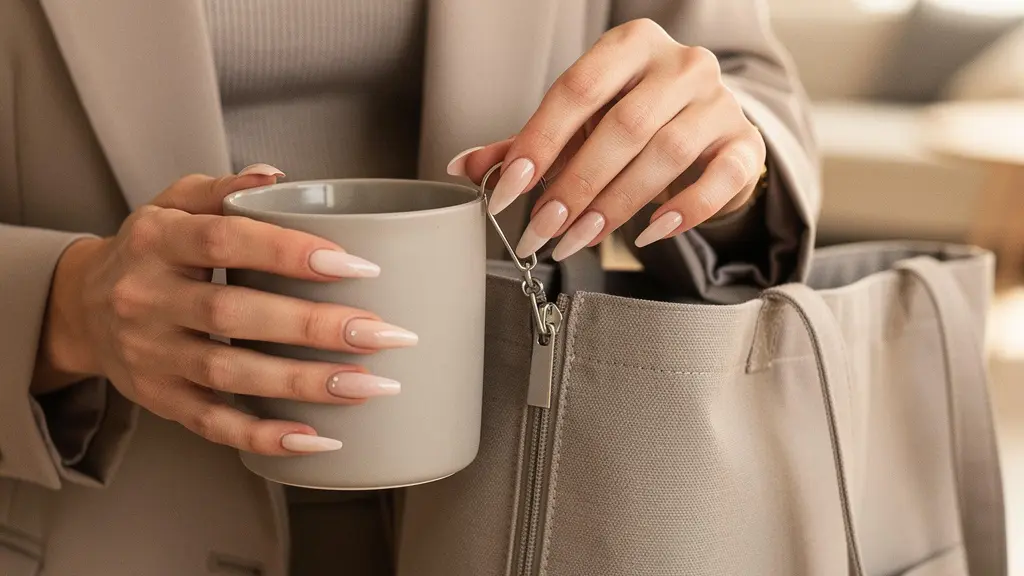
Wearing extreme nails isn’t about giving things up; it’s about mastering the art of functional design.
- Re-engineer your nail’s structure for strength by understanding that a properly placed apex is your greatest asset.
- Adapt your movements and use tools to interact with the world, turning daily challenges into solvable puzzles.
Recommendation: Start by focusing on one functional hack, like the ‘knuckle technique’ for keypads, to build muscle memory and confidence.
You see them all over your feed: impossibly long, exquisitely shaped stiletto nails that look like pure art. For a fashion student, they’re the ultimate statement. But then reality hits. How do you text? How do you type that 10-page paper? How do you avoid the sheer panic that comes with dropping a credit card? The common advice feels lackluster—”just be careful,” “use a spoon to open cans,” or “you’ll get used to it.” These tips barely scratch the surface of a lifestyle that embraces extreme beauty, which includes everything from intricate nail architecture to bold tooth gems.
But what if the secret wasn’t about limiting your life to accommodate your nails, but about intelligently engineering both your nails and your habits for a functional, fierce life? This isn’t about sacrificing your art; it’s about making it wearable. The key is to shift your mindset from one of passive adaptation to one of active problem-solving. It involves understanding the structural integrity of your extensions, mastering ergonomic adaptations for daily tasks, and even developing social scripts to handle the inevitable questions with grace and power.
This guide is your new playbook. We’re moving beyond basic tips to give you the strategic hacks you need. We’ll deconstruct the physics of a strong nail, teach you how to redesign your interactions with everyday objects, and empower you to transform your impractical-looking nails into a seamless extension of your personal style. It’s time to stop worrying and start living—beautifully and functionally.
Before mastering the lifestyle, it’s essential to understand the fundamentals of nail structure. For our visual learners, the following video offers a great primer on the basics of acrylic shaping and technique, which forms the foundation of all strong extensions.
This article is designed as a masterclass to guide you through every aspect of living with and loving your long nails. Below is a roadmap of the key strategies we will cover, from the technical to the social, ensuring you’re equipped for any situation.
Table of Contents: Your Masterclass in Wearable Nail Art
- The “Knuckle” Technique: How to Use ATMs with Extra Long Nails?
- Why Avant-Garde Shapes Need a Thicker Apex placement?
- Negative Space in Extreme Shapes: Balancing Bulk with Airiness
- Dealing with Questions: How to Answer “How Do You Wipe?” Gracefully?
- Using Peel-Base for Avant-Garde Looks: Is It Safe for Heavy Art?
- How to Type at 80 WPM With Stiletto Nails Without Typos?
- Can Stiletto Nails Ever Be Appropriate for a Corporate Boardroom?
- How to Adapt Impractical Runway Nails for Office Clients?
The “Knuckle” Technique: How to Use ATMs with Extra Long Nails?
Public touchscreens, gas pumps, and ATMs are the first major hurdle for anyone with fresh extensions. These high-touch zones are not just a logistical challenge; they are high-frequency interaction points. Observational research confirms that people in places like airports touch public surfaces in self-service areas up to 473.5 times per hour, making a functional strategy non-negotiable. The answer isn’t to avoid these machines but to change your physical interface with them. This is where you master the “knuckle technique.”
Instead of using the pad of your fingertip, which is now obstructed, you use the flat, bony surface of your knuckle to press buttons. This requires a conscious shift in muscle memory. Approach the keypad by turning your hand slightly, so your knuckle becomes the primary point of contact. Stabilize your hand by bracing your palm against the machine’s housing to prevent your nail tip from taking any leverage or impact. Use a deliberate, rolling press rather than a sharp jab. This small change in motor pattern protects the nail’s structure from direct pressure and the risk of chipping or snapping.
For tasks that require pinching, like pulling your card from a tight slot, forcing your nails is a recipe for disaster. This is where you embrace tool integration. A simple “card grabber” keychain, a small clip designed to grip your card, eliminates the need to jam your fingers into a narrow space. These tools are a prime example of how the long-nail community creates accessory micro-markets to solve functional problems, turning an inconvenience into a stylish and practical hack. Adopting these techniques is a behavioral change that makes daily errands seamless.
Why Avant-Garde Shapes Need a Thicker Apex Placement?
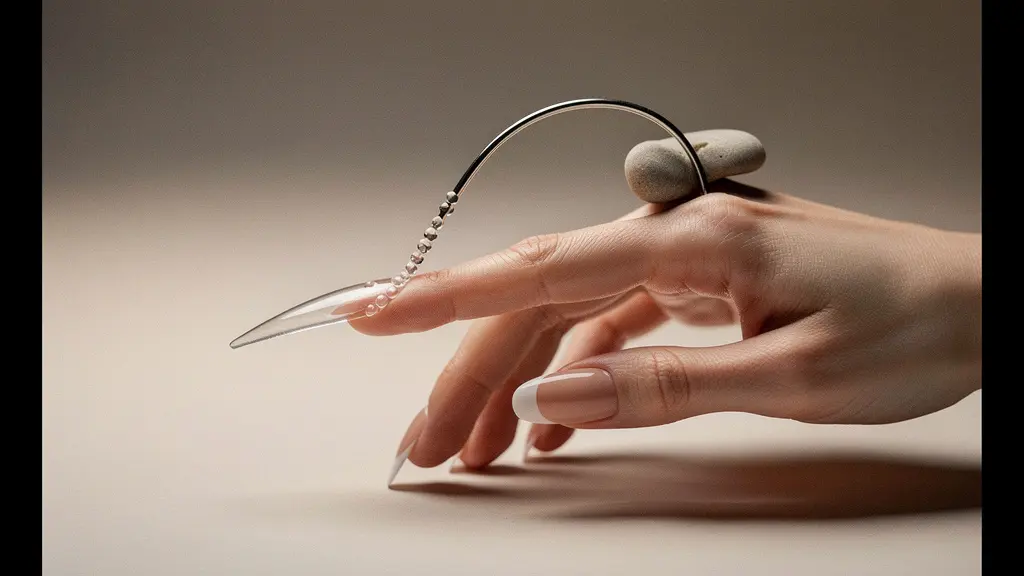
The secret to wearing gravity-defying stiletto nails without constant breaks isn’t nail glue or blind hope—it’s physics. The structural integrity of a long extension hinges entirely on the placement and thickness of its apex. The apex is the highest point of the nail enhancement, the “hump” that acts as a stress absorber and structural support. On a short nail, the apex is centered. On a long nail, this would create a front-heavy imbalance, putting immense pressure on the stress area near your cuticle and making the tip fragile.
For avant-garde lengths, you must treat the apex as a counterbalance. It should be placed further back, over the natural nail’s stress area (typically in the back third of the nail bed). This placement shifts the balance point closer to your finger, distributing pressure evenly and preventing the nail from acting like a lever that can lift or snap. Before finishing, a skilled technician always checks the side profile to ensure a smooth, continuous arch with no flat spots, which are weak points.
While competition rules for sculptured nails often specify details like C-curves between 40% and 50% to formalize strength, the principle is universal: structure is paramount. The image below illustrates how the apex acts as this crucial counterbalance, providing strength without adding visible bulk from the top view.
As your natural nail grows, this perfectly placed apex migrates forward, throwing the balance off. That’s why maintenance at the 3-4 week mark isn’t just a “fill”—it’s a rebalancing appointment. Your technician must restructure the nail to move the apex back to its functional zone. This is the engineering that makes wearable art possible.
Negative Space in Extreme Shapes: Balancing Bulk with Airiness
Extreme length and complex shapes can sometimes feel visually heavy or overwhelming. The pro secret to making them look elegant and sophisticated, rather than bulky, is the masterful use of negative space. In design, negative space is the empty area around and between subjects. In nail art, it’s a powerful tool for creating airiness, balance, and a lighter feel without sacrificing the dramatic silhouette of a long stiletto.
Instead of a solid, opaque color from cuticle to tip, incorporating clear or bare sections breaks up the visual mass. This gives the eye a place to rest and creates an illusion of delicacy. A popular runway technique, as noted in fashion-month reports, is to leave the lower half of the nail bare or to specifically highlight the lunula (the crescent at the nail base). This strategy keeps the focus on the elongated shape and dramatic tip while grounding the look with a touch of naturalness. It makes the extreme feel more intentional and approachable.
This technique is also brilliantly functional. Leaving a half-moon of negative space near the cuticle line is a classic trick to camouflage regrowth, extending the life of your manicure between appointments. As your nail grows out, the gap looks like a deliberate design choice rather than an overdue fill. Furthermore, for complex 3D designs, clear builder gel can be used to create “structural beams” across cutouts, providing the necessary strength for the design while remaining invisible and maintaining the airy, see-through aesthetic. This is aesthetic engineering at its finest.
Dealing with Questions: How to Answer “How Do You Wipe?” Gracefully?
Wear a piece of statement art, and you will get questions. While most are compliments, extreme nails often attract one particularly invasive query: “How do you… you know… wipe?” This question, though often asked out of naive curiosity, can feel intrusive and othering. How you handle it is a test of grace and a crucial part of owning your style. Your response shouldn’t be defensive or awkward; it should be a calm exercise in boundary setting.
As psychologist Dr. Cortney S. Warren notes, boundaries are about managing expectations in relationships, even brief ones with strangers. Your personal hygiene is a private matter, and you are not obligated to explain it.
“Simply put, boundaries are relationship expectations.”
– Dr. Cortney S. Warren, PhD, CNBC
The most powerful response is one that is brief, neutral, and redirects the conversation. This approach is backed by research on handling inappropriate questions, which shows that direct deflection is often more effective than confrontation or over-sharing. Instead of getting flustered, have a prepared “educational pivot” script ready. It acknowledges the topic without indulging the intrusion.
Your Action Plan: The ‘Educational Pivot’ Hygiene Script
- Keep your tone neutral and brief: Start with a simple, non-emotional statement like, “I handle hygiene just fine—thanks for checking.”
- Pivot to a tool or fact: If you choose, you can pivot to a factual, non-graphic point. “Many people use a portable bidet, it’s actually much cleaner.” This educates without sharing personal details.
- Set a clear boundary if they push: If the person persists, be direct. “That’s a private question. Anyway, let’s talk about something else.”
- Keep any education clinical: If you do explain a tool like a bidet, stick to the facts: use warm water, clean front-to-back, and dry thoroughly to prevent irritation. No jokes, no defensiveness.
- End the interaction gracefully: Immediately redirect the conversation to a normal topic to signal the discussion is over. “Anyway—how has your week been?”
Using Peel-Base for Avant-Garde Looks: Is It Safe for Heavy Art?
For the fashion student who loves to change their nails with their outfits, peel-off base coats seem like a holy grail. They promise the durability of gel with the ease of temporary polish, allowing for quick changes without a lengthy acetone soak. But when you’re dealing with heavy 3D art, charms, and structurally demanding shapes, the question of safety and stability becomes critical. Is a peel-off base strong enough to support an avant-garde look, and is it truly damage-free?
The first thing to understand is that peel-base is a short-wear strategy. It’s perfect for a weekend event, a photoshoot, or creating content, but it is not designed for long-term retention under heavy load. The adhesion is intentionally weaker. Placing bulky elements, especially near the free edge, creates leverage that can cause the enhancement to pop off prematurely—or worse, peel off unevenly and take a layer of your natural nail with it. If you feel resistance when removing, do not rip it off. Soften the edges with oil or warm water first.
Safety is also a nuanced topic. While designed to be gentler, “safer” does not mean allergy-proof. A 2024 clinical report highlighted a case of allergic contact dermatitis from a “HEMA-free” gel, reminding us that other acrylates can still be triggers. It’s wise to check product ingredients; for example, an independent database gives one popular peel-off gel base a product score of 3 on its hazard scale, indicating moderate concern. If your nail plate is already thin or damaged, be extra cautious, as forced peeling can worsen the issue. After every removal, rehydrate religiously with cuticle oil and hand cream to restore moisture.
How to Type at 80 WPM With Stiletto Nails Without Typos?
The click-clack of long nails on a keyboard can be iconic, but for a student or professional, typing speed and accuracy are non-negotiable. It is absolutely possible to type efficiently with stilettos; it just requires a fundamental change in your typing posture. You can no longer rely on the tips of your fingers. The new technique is all about using the pads of your fingers and adopting an ergonomic “hover hands” position.
This method involves keeping your wrists straight and floating above the keyboard, rather than resting them on a wrist-pad or desk. This posture forces you to use a lighter touch and strike the keys with the fleshy pad of your finger, just below the nail. Your fingers should be naturally curved, and the motion should be a controlled tap, not a forceful press. This not only reduces impact on your nails but also minimizes typing noise and strain. Adjusting your chair and keyboard height so your elbows are at a comfortable 90-degree angle is crucial for maintaining this posture without fatigue.
For days when your nails are freshly done or you’re facing a marathon typing session, you can also turn to “interface mediation”—using a tool to type for you. A viral clip highlighted a genius real-world hack where an office worker typed by holding two pens with the caps on, using the blunt ends to strike the keys. This completely eliminates direct nail-to-key contact, protecting your manicure while maintaining speed. Whether you use pens, a stylus, or simply master the hover technique, the key is to stop thinking of your nails as an obstacle and start adapting your ergonomics to work with them.
Can Stiletto Nails Ever Be Appropriate for a Corporate Boardroom?
The corporate world has traditionally been the domain of the understated French manicure and short, practical nails. So, can a two-inch stiletto ever find its place in a boardroom? The answer is a resounding yes, but it requires a strategic approach. It’s not about the nail itself, but about the context and the overall styling. When executed with intention, an extreme nail can signal power, polish, and attention to detail rather than frivolity.
Think of it like high fashion in politics. A recent Marie Claire feature documented how a new generation of leaders in Washington, D.C. are using expressive fashion to challenge old-school dress codes, framing their style as an extension of their identity and authority. The same principle applies here. When your entire look is cohesive, impeccably tailored, and professional, your nails become a controlled statement accent, not a distraction. The key is to balance the “statement” element. If your nails are the statement, keep your jewelry minimal and your outfit classic.
To make stilettos boardroom-appropriate, prioritize subtlety and immaculate maintenance. Opt for a neutral, nude, or deep monochromatic color in a sophisticated matte or cream finish. Avoid loud glitter, excessive 3D art, or clashing colors. A clever trick is to keep the top view conservative and place a pop of color on the underside—a “Louboutin” manicure—that only flashes when you gesture. Most importantly, your nails must be flawless: no chips, no lifting, and a clean cuticle line. This demonstrates that your choice is a matter of grooming and personal branding, not a passing trend. It’s about owning your power, right down to your fingertips.
Key Takeaways
- The secret to long nails is engineering, not just caution. A properly placed apex is your best friend for strength and durability.
- Redesign your interactions: use knuckles, tools, and new motor patterns instead of forcing your fingertips in daily tasks.
- Own the conversation. Treat invasive questions as a chance to set boundaries and educate, not as a moment of shame.
How to Adapt Impractical Runway Nails for Office Clients?
Runway nails are pure fantasy—designed for a 10-minute walk under specific lighting. They are built for photographic impact, not for typing memos or opening file cabinets. As a future pro or a savvy client, it’s crucial to understand how to translate that high-fashion inspiration into a wearable, office-functional reality. The first secret is knowing that runway nails are often press-ons. For Vogue World: Paris, the lead manicurist created hundreds of sets in advance, highlighting that they’re engineered for speed and temporary wear, not daily friction.
The key to adaptation is making micro-modifications that preserve the silhouette while improving function. A true, needle-sharp stiletto can be softened into an “almond-stiletto” hybrid. This tiny rounding of the tip is imperceptible from a distance but makes a world of difference in preventing snags on clothing and paperwork. Similarly, the dramatic “hook” or deep C-curve of a competition nail can be toned down. For a concrete benchmark, nail competition criteria often list a C-curve depth between 33.33% and 40%; a salon-wearable version would be on the lower end of that spectrum or even slightly less.
A smart technician can also create the illusion of a razor-sharp taper by expertly filing the sidewalls while keeping structural thickness hidden along the nail’s central axis. The top-down view looks sleek and thin, but the side profile reveals the strength is still there. Reinforcing the tip with controlled, thin layers of product adds durability without creating a bulky, heavy end. By deconstructing the runway look into its core elements—length, shape, and color—you can choose which to emphasize while modifying the others for real life. This is how you take inspiration from the couture and make it work for the cubicle.
Now that you have the playbook, stop dreaming about extreme nails and start engineering them for your life. Your next step? Choose one technique from this guide and practice it for a week. Master the machine.