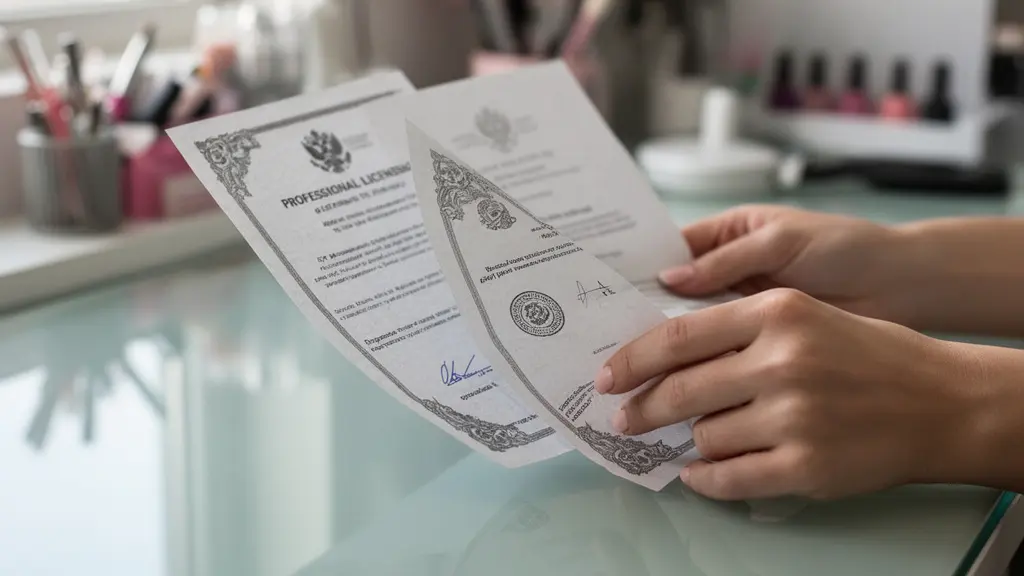
A state-issued license is the sole legal credential permitting nail services; certificates merely indicate educational completion and confer zero legal authority to practice.
- State training mandates range from 100 to 750 hours, creating significant regulatory fragmentation across jurisdictions.
- Liability exposure persists even in salon employment without personal coverage verification.
Recommendation: Verify state board licensure requirements before enrolling in any educational program to ensure statutory compliance.
The proliferation of online nail technology courses promising instant “certification” has created widespread confusion among aspiring technicians. These programs often imply that their completion certificates satisfy legal requirements for professional practice—a misconception that exposes graduates to administrative penalties and civil liability. While industry certificates demonstrate educational achievement in specific techniques, they do not constitute the statutory licensure required by state cosmetology boards. This distinction between educational credentials and legal authority forms the foundation of professional compliance. Understanding the regulatory hierarchy—where state mandates supersede institutional certificates—is essential for navigating training requirements, insurance obligations, and scope-of-practice limitations. This analysis examines the statutory framework governing nail technology practice, exposing the liability risks of credential misrepresentation while providing a roadmap for legally compliant career entry.
For those preparing for the Kentucky State Board examination, the following video provides a comprehensive visual guide to the PSI testing process, complementing the regulatory framework discussed in this analysis.
To navigate the statutory landscape effectively, this examination proceeds through eight critical regulatory domains, from initial training hour variations to long-term career ROI calculations.
Table of Contents: Legal Requirements and Professional Standards for Nail Technicians
- Why Do Hours Required for Licensing Vary so Much by State?
- Liability Insurance: Do You Need It If You Work in a Salon?
- CEUs: How to Maintain Your License Without Repeating Basics?
- Can Nail Techs Legally Perform Waxing or Eyelash Services?
- What Are the Instant-Fail Violations During a State Board Inspection?
- The Blue Liquid Myth: Is Barbicide Actually Effective If Not Changed?
- Pouches and Indicators: How to Prove the Tools Are Sterile?
- Nails Only vs. Full Esthetics: Which License Offers Better ROI?
Why Do Hours Required for Licensing Vary so Much by State?
State cosmetology boards operate under independent statutory authority, resulting in training hour requirements ranging from 100 to 750 hours across different jurisdictions. This regulatory fragmentation reflects varying legislative priorities regarding consumer protection versus workforce accessibility. Connecticut mandates only 100 hours, while Alabama requires 750 hours—a disparity that creates significant barriers to interstate mobility for practitioners.
Recent legislative adjustments demonstrate this tension between safety standards and labor market demands. Kentucky reduced its nail technician training requirement from 600 to 450 hours in 2024, strategically aligning with Indiana’s requirements while positioning itself competitively against Tennessee’s 600-hour mandate. This reduction aimed to address documented workforce shortages without compromising safety protocols.
Reciprocity agreements further complicate the landscape. Pennsylvania requires 200 hours with reciprocity available after two years of professional experience, while Delaware mandates 300 hours with a five-year experience threshold. California’s 400-hour requirement operates under limited reciprocity, effectively requiring additional training for out-of-state licensees.
| State | Required Hours | Reciprocity Options |
|---|---|---|
| Pennsylvania | 200 | 2 years experience |
| Delaware | 300 | 5 years experience |
| Florida | 240 | Endorsement available |
| California | 400 | Limited reciprocity |
| Alabama | 750 | Case-by-case |
These variations necessitate careful jurisdictional research before program enrollment, as training requirements vary dramatically from Connecticut’s 100 hours to Alabama’s 750 hours.
Liability Insurance: Do You Need It If You Work in a Salon?
Employment status fundamentally determines insurance obligations for nail technicians. W-2 employees may receive partial coverage under salon policies, while 1099 contractors bear full responsibility for obtaining personal professional liability coverage. This distinction carries significant financial implications, as professional liability insurance costs nail technicians an average of $47 monthly or $567 annually.
Salon policies frequently contain critical exclusions that expose individual practitioners to liability. Coverage gaps typically include personal asset protection, license defense costs, and claims arising from services performed after employment termination. The concept of “acts and omissions” coverage proves particularly relevant, protecting against both errors in services performed and failures to perform required services.
Verification of coverage specifics must occur in writing before service commencement. Technicians should obtain documentation detailing policy limits, exclusions, and post-employment claim coverage. Relying solely on verbal assurances from salon management constitutes a significant liability risk.
Critical Coverage Gaps to Verify
- Verify if salon’s policy covers you after leaving employment
- Check your employment status: W-2 employees may have partial coverage, 1099 contractors need personal policies
- Review what the salon’s policy excludes: personal assets, license protection, post-employment claims
- Understand ‘acts and omissions’ coverage for both mistakes made and services not performed
- Document any gaps in writing and obtain your own supplemental coverage
CEUs: How to Maintain Your License Without Repeating Basics?
Continuing Education Units (CEUs) serve regulatory compliance functions while offering opportunities for service menu expansion and income enhancement. Strategic selection of CEU providers differentiates between mere license maintenance and career advancement. ROI-focused selection criteria prioritize courses enabling technicians to command premium pricing for specialized services.
Advanced certifications in Structured Gel techniques, Medical Pedicures, or Russian Manicure methodologies can add $50 or more per service to standard menu pricing. However, state board approval remains mandatory; technicians must verify provider numbers and approved course lists before payment to ensure credits apply toward renewal requirements.
Unconventional CEU options often provide superior value. Trade show attendance, industry publication contributions, and board examination proctoring may satisfy continuing education requirements in certain jurisdictions while expanding professional networks. Meticulous documentation—including certificates, attendance records, and provider numbers—must be maintained for renewal audits.
Documentation protocols require systematic organization of all CEU completion records. Technicians should retain certificates, attendance verification, and provider accreditation numbers for a minimum of three years beyond the renewal period to satisfy potential audit requirements.
Can Nail Techs Legally Perform Waxing or Eyelash Services?
Scope of practice limitations strictly delineate permissible services based on licensure type. A nail technician license authorizes manicures, pedicures, and nail enhancement applications exclusively. Facial waxing, eyelash extensions, and body treatments fall outside this statutory scope, requiring either a full esthetics license or dual licensure depending on state-specific regulations.
Income potential varies significantly across these credential categories. Analysis demonstrates that nail technicians earn $30,000-$35,000 annually, while estheticians command $38,000-$42,000. Dual-licensed professionals can achieve $45,000-$55,000 by offering comprehensive service menus. The financial calculation proves compelling: a $10,000 additional training investment divided by $3,333 monthly salary differential equals approximately three months to recoup educational costs.
| Service | Nail License | Esthetics License | Dual License |
|---|---|---|---|
| Manicures/Pedicures | ✓ | Limited | ✓ |
| Facial Waxing | ✗ | ✓ | ✓ |
| Eyelash Extensions | ✗ | ✓ | ✓ |
| Body Treatments | ✗ | ✓ | ✓ |
| Income Potential | $30-35K | $38-42K | $45-55K |
Operating outside licensed scope constitutes unlicensed practice, exposing technicians to administrative fines and civil liability. Dual-licensed professionals can command $45-55K by offering comprehensive services, making the additional credential financially justified for career longevity.
What Are the Instant-Fail Violations During a State Board Inspection?
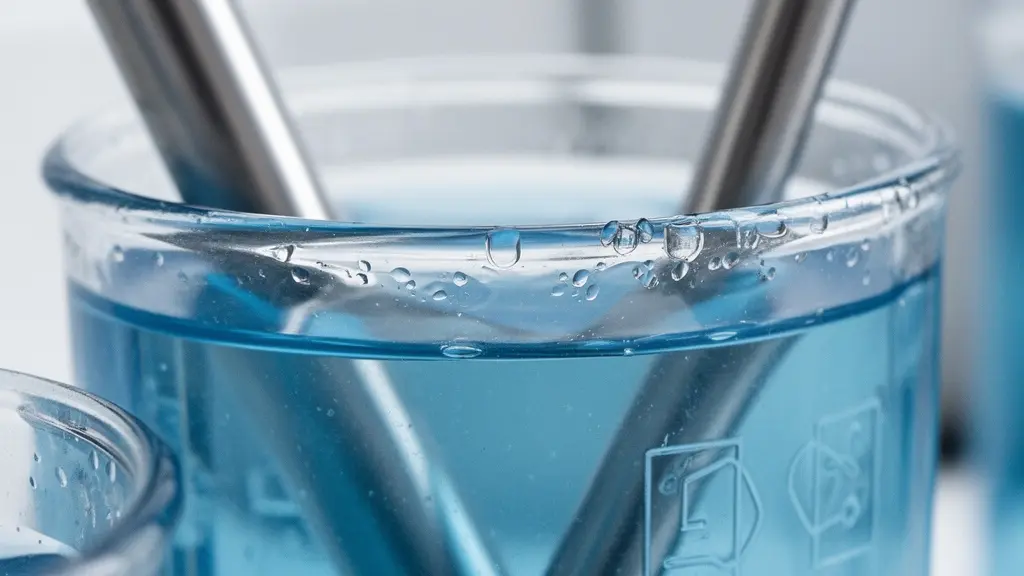
State board inspections operate under zero-tolerance protocols for specific sanitation and safety violations. Visible disinfectant status represents the primary inspection focal point; improperly mixed, undated, or visibly contaminated Barbicide solutions result in immediate citation. Inspectors evaluate compliance within the first five minutes of facility entry, making initial impressions critical for operational continuity.
Single-use item violations constitute another instant-fail category. Reused files, buffers, or orangewood sticks observed during inspection trigger immediate corrective action requirements. Foot spa documentation demands meticulous record-keeping of cleaning and disinfection protocols performed after each client and at day’s end.
Tool storage protocols require covered containers clearly marked “clean” or “dirty” to prevent cross-contamination. Handwashing stations must maintain readily accessible soap, paper towels, and instructional signage in all service areas.
Inspector’s First Five Minutes Checklist
- Visible disinfectant status: Properly mixed, labeled, and dated Barbicide or EPA-registered solution
- Single-use items disposal: No reused files, buffers, or orangewood sticks visible
- Foot spa logs: Cleaning/disinfection documented after each client and end of day
- Tool storage: Implements in covered containers marked ‘clean’ or ‘dirty’
- Handwashing station: Soap, paper towels, and signage readily accessible
The Blue Liquid Myth: Is Barbicide Actually Effective If Not Changed?
The visual persistence of blue coloring in disinfectant solutions creates a dangerous misconception regarding efficacy. EPA-registered hospital-grade disinfectants like Barbicide require specific chemical concentrations to maintain biocidal properties. The accumulation of “organic load”—skin cells, oils, and biological debris—chemically neutralizes active ingredients, rendering solutions ineffective despite appearing visually unchanged.
Manufacturer instructions establish the legal standard of care for sanitation protocols. These specifications dictate specific dilution ratios, contact times, and replacement frequencies that become admissible evidence in liability proceedings. Deviation from printed protocols constitutes negligence per se in many jurisdictions.
Quaternary ammonium test strips provide objective verification of chemical concentration. These diagnostic tools must be utilized every two hours during operational periods to ensure ongoing efficacy. Solutions failing strip verification require immediate replacement regardless of apparent visual clarity.
Disinfectant Testing Protocol
- Mix fresh solution daily according to manufacturer’s ratio (typically 2 oz per 32 oz water)
- Use quaternary ammonium (Quat) test strips every 2 hours to verify concentration
- Document concentration levels in sanitation log with time and initials
- Replace solution immediately if test strips show inadequate levels
- Store test strips in cool, dry place and check expiration dates monthly
Documentation of test strip results creates a defensible record of due diligence. Technicians should maintain sanitation logs recording concentration levels, testing times, and operator initials to demonstrate compliance during regulatory inspections or liability proceedings.
Pouches and Indicators: How to Prove the Tools Are Sterile?
Demonstrable sterilization requires comprehensive documentation systems extending beyond visual packaging inspection. Class 5 integrating indicators placed inside each pouch provide definitive evidence of sterilization parameter achievement, unlike external process indicators that merely confirm package exposure to the sterilization environment. This distinction proves critical in liability defense and regulatory compliance.
Biological spore testing conducted through mail-in laboratory services provides the gold standard for sterilization verification. Weekly testing protocols identify sterilization equipment failures before client exposure occurs. Results must be maintained on file for a minimum of three years to satisfy legal discovery requirements and board audit protocols.
Opening a new, sterile pouch of tools for every single client is our top priority for safety
– State Board Inspector, Professional Nail Technician Safety Standards Guide
Sterilization logs must document cycle dates, equipment numbers, operator initials, and indicator results for each processed batch. Pouch storage requires visible dating to ensure first-in-first-out usage patterns and prevent expiration of sterile supplies.
Complete Sterilization Documentation System
- Use Class 5 integrating indicators inside each pouch (not just process indicators outside)
- Conduct weekly biological spore tests using mail-in service
- Maintain sterilization log: Date, cycle number, operator initials, indicator results
- Store pouches with date of sterilization visible
- Keep spore test results on file for minimum 3 years for legal protection
Key Takeaways
- State licensure—not certificates—confers legal authority to practice nail technology
- Training requirements vary from 100 to 750 hours depending on state jurisdiction
- Professional liability insurance remains essential regardless of employment status
- Scope-of-practice violations expose technicians to administrative and civil penalties
- Sterilization documentation requires Class 5 indicators and biological spore testing
Nails Only vs. Full Esthetics: Which License Offers Better ROI?
Return on investment calculations for professional licensing must account for training costs, duration, and income potential across career trajectories. Nail-only licensure offers accelerated workforce entry with lower capital requirements, while full esthetics provides broader service capabilities and higher income ceilings. The optimal choice depends on individual financial constraints and long-term career objectives.
Comparative analysis reveals distinct break-even timelines. Nail technicians recoup their $4,000 tuition investment in just 1.6 months, compared to three months for estheticians facing $6,000-$12,000 training costs. However, median annual income differentials favor esthetics at $38,000-$42,000 versus $30,000-$35,000 for nail-only practitioners.
| Factor | Nails Only | Full Esthetics |
|---|---|---|
| Training Cost | $3,000-5,000 | $6,000-12,000 |
| Training Duration | 2-4 months | 6-9 months |
| Median Annual Income | $30,000-35,000 | $38,000-42,000 |
| Specialization Potential | High (nail art, structured gel) | Moderate (diverse services) |
| Employment Growth Rate | 12% (2023-2033) | 9% (2023-2033) |
Employment projections indicate 12% growth for nail technicians versus 9% for estheticians through 2033, suggesting stronger demand for specialized nail services. Dual-licensure strategies maximize market flexibility but require significant additional investment. Career planning should prioritize immediate income needs against long-term specialization opportunities, recognizing that advanced nail techniques command premium pricing comparable to esthetics services.
Evaluate your jurisdiction’s specific training mandates and employment market conditions to determine the optimal credential pathway for your professional objectives.